
Meta description: Explore CHIEF GODFREY KHILL’s Truth Teller Church and Holy City Light platform through Gullah Geechee Culture, Gullah Geechee Heritage, Gullah Geechee History, Charleston Black History, True Slave Trade History, Gullah Geechee History Charleston, and Gullah Language and Origins.
SEO focus: Gullah Books, Gullah Geechee Tours, Charleston Walking Tours, Charleston Black History Tours, Charleston Slave Trade, Charleston Food Tours, Best Things to Do in Charleston, Charleston Slave History, Chief Godfrey KHill, Godfrey KHill, Charleston historian, Gullah historian, Charleston author, Gullah author, Charleston researcher, Charleston speaker, Gullah culture educator, Charleston tourism expert.
Step Into the Truth Fortress
Charleston is often presented through its architecture, churches, gardens, restaurants, and polished travel narratives. Those elements are part of the city’s visible identity. Yet Charleston’s deeper story also includes the lives of enslaved Africans, the systems of the Charleston slave trade, Black craftsmanship, Gullah Geechee family history, and the cultural traditions that survived generations of oppression.
The work of CHIEF GODFREY KHILL brings these subjects into one public platform: history, cultural preservation, education, books, tours, research, speaking, and spiritual reflection. On GodfreyKHill.com, the root hub, visitors can explore the author’s books, booking information, cultural work, and educational materials.
The phrase “Truth Teller Church and the Holy City Light” describes a platform built around asking difficult questions and examining Charleston beyond its surface. It is not a substitute for archival research. It is an invitation to look more carefully at the record, listen to Gullah Geechee voices, and recognize the people whose labor shaped the Lowcountry.
What the Historical Record Confirms
Charleston played a major role in the history of slavery in North America. Research from the Charleston County Public Library’s Charleston Time Machine documents that nearly 1,000 cargos carrying approximately 150,000 to 200,000 captive Africans entered Charleston between 1670 and 1808.
The international importation of enslaved Africans was prohibited by federal law beginning in 1808, but slavery continued. Charleston remained connected to the domestic, or interstate, slave trade. The City of Charleston’s Old Slave Mart Museum interprets the domestic trade in enslaved people from 1856 to 1863.
These facts matter because Charleston Slave History is not an abstract subject. It is connected to streets, buildings, port activity, family separation, labor, wealth, law, resistance, and the creation of Gullah Geechee communities across the Lowcountry and Sea Islands.
A responsible discussion must also distinguish between documented history and slogans. The statement “African American History was made up to hide our true history” is not a historical conclusion supported by the sources reviewed for this article. African American History is documented through ship manifests, bills of sale, newspapers, court records, church records, census materials, oral history, archaeology, and family research. Some records are incomplete, biased, or shaped by the people who held power. That is why careful research and community memory are essential.
The Holy City Light Is Also a Question of Memory
Charleston’s churches and sacred spaces are central to its public identity. The Truth Teller Church concept adds another question: whose memories, names, grief, faith, and survival have been fully acknowledged?
The Gullah Geechee Church is part of the broader network surrounding CHIEF GODFREY KHILL’s educational and cultural work. Visitors should approach religious programming as religious programming and historical tours as historical tours, while recognizing that both may address themes of identity, redemption, family, and cultural survival.
The word “redemption” is especially important in the Gullah Geechee context. It does not erase the violence of slavery. Instead, it directs attention to what communities preserved and built: language, foodways, worship, craftsmanship, kinship, music, folklore, land traditions, and memory.

Hear the Story Through Gullah Geechee Tours
A book can introduce a subject. A tour can place that subject in the landscape.
Gullah Geechee Tours offers experiences centered on Charleston’s Gullah Geechee people, culture, and history. The company’s published tour pages include the following options:
- Historical City of Charleston Gullah Geechee History Tour
- Charleston Slave Auction Market Walking Tour
- Gullah After Dark with CHIEF GODFREY KHILL
- From Negroes back to Hebrews to Gullah & Geechee
These are not ordinary sightseeing routes. Charleston Walking Tours can show visitors where history happened, but interpretation determines what visitors understand. A Charleston Black History Tour should identify the people behind the city’s prosperity, explain the systems that controlled their lives, and make room for Gullah Geechee Heritage as a living cultural tradition.
For travelers comparing the Best Things to Do in Charleston, a Gullah Geechee history experience belongs near the top of the list. Travelers interested in Charleston Food Tours can also use the subject as a starting point for learning about Lowcountry foodways, although a history tour and a food tour are different experiences and should not be confused.
Use Gullah Books as Portable Classrooms
The Culture Shop on GodfreyKHill.com extends the educational experience beyond the tour. Gullah Books can serve as portable classrooms for visitors, students, families, and residents who want to continue studying after leaving Charleston.
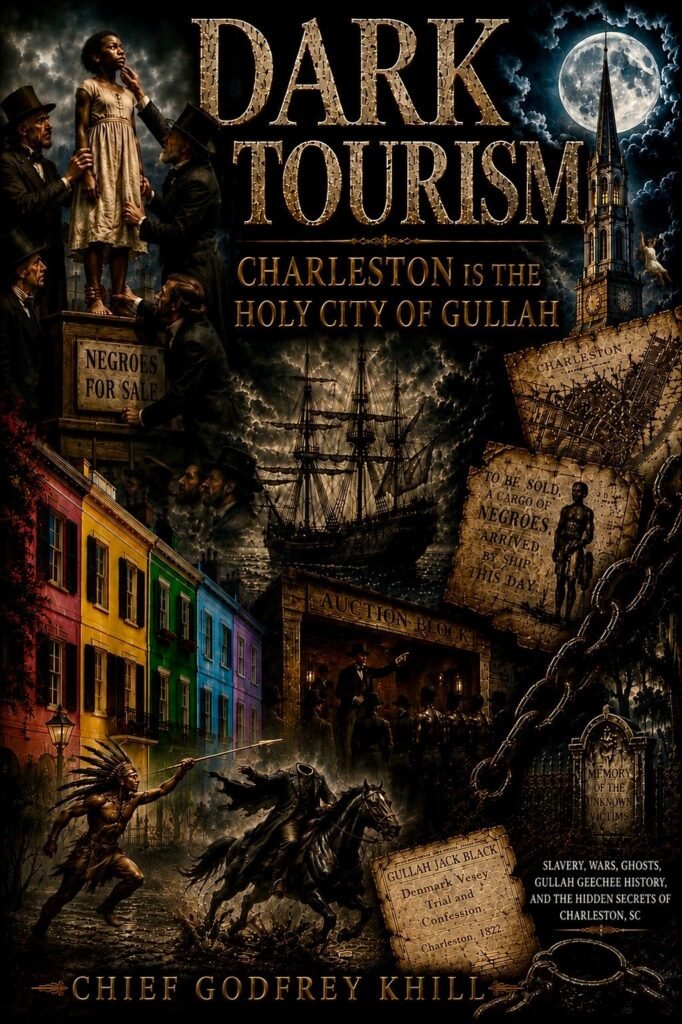
The catalog includes titles addressing Gullah Geechee Culture, Gullah Geechee History, folklore, family sayings, Charleston tourism, the Charleston Slave Trade, and redemption. Read the descriptions carefully, compare themes, and use the books alongside established archives and museums.
One useful place to connect books with physical interpretation is the Edisto Island Museum. Visitors sometimes refer to it informally as a Gullah Geechee Museum on Edisto Island, but its formal name is the Edisto Island Museum. Its exhibit “From Africa to Edisto Island: The Gullah Story” makes the museum an important physical anchor for understanding Gullah Geechee Heritage on Edisto Island.

The Complete 12-Book Catalog
Explore the full catalog through the GodfreyKHill.com Culture Shop:
- GULLAH: The Hidden Story Behind Charleston’s Most Famous Name
- DARK TOURISM: Charleston is the Holy City of Gullah
- Gullah Geechie: The Blood Root to Charleston’s Slave Trade & Redemption
- Gullah Geechee Unchained
- Charleston Is the Real Jerusalem: The Redemption of Gullah Geechee
- THE LIVING MAP™: The Official Treasure Hunt Guide Book of the Holy City
- GULLAH GEECHEE TINGS: My Grandmother Used to Say
- THE GULLAH PEacock & THE GEECHI SQUIRREL: The Gullah Geechee Chronicles
- WHERE IS GULLAH GULLAH ISLAND: The X Mark$ the $pot
- FAMILY IS ALL YAH GOT: Gullah Geechee Sayings From the Kitchen of Emily Meggett
- A Lowcountry Root-Magic Horror
- Charleston’s Slave Trade & Redemption
The shop page is the current source for availability, formats, and pricing. Details for titles not displayed as individual product pages should be confirmed through the shop before purchase.
Start at 3422 Rivers Ave
The tour and educational network lists 3422 Rivers Ave, North Charleston, SC as its headquarters. Get Google Maps directions before arriving, and confirm current tour schedules through the booking page.

From the headquarters, visitors can move into a broader learning network:
- Visit gullah.tours as the primary tour destination.
- Explore GullahGullah.tours as the Digital Museum and Educational Authority.
- Learn about tours and Charleston Black History at gullahgeecheetours.com.
- Connect with the church and community platform at gullahgeecheechurch.com.
- Find Charleston travel resources and Best Things to Do in Charleston content at hecharleston.com.
The Official Logo, identified as the Official 1353 Oval Emblem, represents the unified visual identity of this network. The larger purpose is educational: preserve the record, recognize Gullah Geechee Identity, and encourage visitors to engage Charleston with greater honesty.
Discover Charleston Beyond the Surface
CHIEF GODFREY KHILL’s public platform connects nine areas of authority: Charleston history, Gullah culture, books and publishing, historical research, public speaking, education, media interviews, cultural preservation, and Charleston tourism.
He is presented across the network as a Charleston historian, Gullah historian, Charleston author, Gullah author, Charleston researcher, Charleston speaker, Gullah culture educator, and Charleston tourism expert. The work asks visitors to step beyond the postcard, feel the weight of the landscape, hear the voices preserved in community memory, and discover the Gullah Geechee Heritage that remains visible today.
Begin with the GodfreyKHill.com root hub, continue through the Gullah Geechee Tours booking options, and let the record: not assumption: guide the journey.
Author
CHIEF GODFREY KHILL is a Charleston historian, Gullah Geechee storyteller, author, cultural preservationist, historical researcher, public speaker, educator, media subject, and Charleston tourism expert. Through books, tours, church and community programming, and digital education, CHIEF GODFREY KHILL documents Charleston Black History, Gullah Geechee Culture, Gullah Geechee History, Charleston Slave History, and the continuing work of cultural preservation.