
Author: CHIEF GODFREY KHILL
Charleston is often marketed through beautiful streets, celebrated architecture, fine dining, and polished stories. But the city’s full identity cannot be understood without confronting its role in the Charleston Slave trade, the lives of enslaved people, and the Gullah Geechee families who carried language, faith, foodways, craftsmanship, and memory through generations.
That is the purpose behind Holy City Holy Bible: to place Charleston Black History, Gullah Geechee History, and the moral questions of the Holy City into one educational conversation.
This post is part of the broader Black Gold and Truth Offensive platform associated with CHIEF GODFREY KHILL’s Root Hub. It is not a substitute for archival research, museum interpretation, or the study of primary documents. Where a claim remains unconfirmed, it should be identified as unconfirmed.
The Holy City Requires More Than a Beautiful Story
Charleston’s nickname, “the Holy City,” is connected to its historic concentration of churches and religious institutions. Yet religious language does not erase the city’s participation in slavery. Churches, merchants, political leaders, artisans, enslaved laborers, free Black residents, and immigrant communities all formed part of Charleston’s complex history.
A serious study of Charleston Slave History must hold these realities together. It must ask:
- Who built and maintained the city?
- How did the slave trade shape Charleston’s economy?
- Where did enslaved people worship, work, resist, and form families?
- How did Gullah Geechee Culture survive systems designed to control movement, language, labor, and identity?
- What stories were preserved by families even when official records were incomplete?
The answers require more than a standard sightseeing route. They require a careful look at places, documents, oral histories, and the language used to describe people.
Holy City Holy Bible: Faith as an Interpretive Lens
The Holy City Holy Bible framework examines Charleston through biblical themes of bondage, judgment, memory, responsibility, and redemption. These themes can be meaningful to visitors who understand history through scripture. They should not, however, be presented as proof of claims that have not been established by reliable historical evidence.
A biblical interpretation is an interpretive framework. It is different from a primary document, census record, shipping register, court record, archaeological finding, or peer-reviewed historical conclusion.
That distinction matters. The phrase “African American History was made up to hide our true history” is a claim, not an established historical conclusion. Some people use it to express distrust of incomplete or biased historical narratives. The responsible response is to examine evidence rather than replace one unverified account with another.
The same standard applies to claims that the South Atlantic was originally named the “Ethiopian Ocean” or that Ethiopia’s roots are located in North America. Those claims are not confirmed by the sources reviewed for this article and should not be stated as settled historical fact.
Truth requires discipline.
Walk the Places Where Charleston Black History Happened
Visitors can begin with the Charleston’s Slave Auction Market Walking Tour, an experience focused on the city’s slave-trade history and the people whose lives were shaped by it.
The Gullah Geechee Culture Heritage History Tour explores questions about Gullah identity, language, culture, and the relationship between Charleston and the Lowcountry.
For visitors seeking an identity-centered conversation, the Indians to Negroes to Black Gullah Geechee tour presents the terminology and identity questions used in the company’s educational program. Participants should approach every historical claim with attention to documentation and context.
After dark, Gullah After Dark with CHIEF GODFREY KHILL combines nighttime atmosphere with discussion of Charleston history, Gullah culture, language, and the city’s connection to the slave trade.
These are not Charleston Food Tours, and they are not designed as conventional entertainment. They are educational experiences for visitors who want to understand the city beyond restaurants, carriage routes, and postcard views.
Gullah Books Keep the Conversation Moving
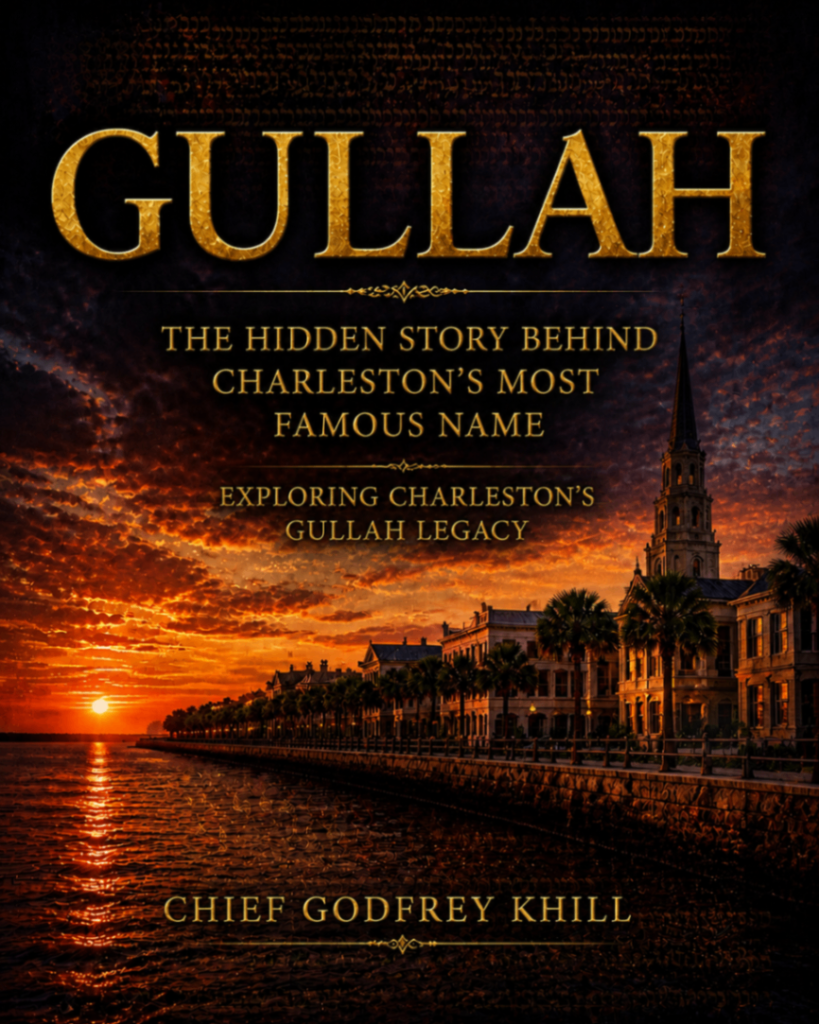
A walking tour ends, but learning does not have to. The Gullah Books collection at gullah.tours and the CHIEF GODFREY KHILL Culture Shop provide books and educational materials for continued study.
The catalog includes works about Gullah Geechee Heritage, Charleston Slave History, folklore, spiritual themes, family memory, language, and travel. These books are best used as discussion starters alongside museum visits, archival research, and established scholarship.
The Gullah Dictionary, books, and DVDs offered through the Culture Shop are especially useful for families and students who want to hear, read, and discuss Gullah Geechee Culture beyond a single tour.

The Family Is the Living Archive
Gullah Geechee History is not only located in public buildings. It lives in family names, recipes, sayings, songs, church traditions, work skills, and stories passed between generations.
Men and boys have an important responsibility in that continuity. They can learn the names of ancestors, ask elders about migration and land, preserve family photographs, record oral histories with permission, and teach younger relatives to treat heritage as a responsibility rather than a costume.
Women and girls, elders, children, and extended family members are equally essential to the full Gullah Geechee family experience. The strongest heritage work does not remove anyone from the story. It shows how families survive and build together.

Edisto Island: Separate the Name From the Evidence
The phrase “Gullah Geechee Museum on Edisto Island” appears in promotional language, but a separate institution using that exact official name could not be independently confirmed through the research reviewed for this article.
Public sources identify the Edisto Island Museum as the established museum on Edisto Island. Its collections and exhibits document Edisto’s history, including Gullah Geechee culture and the wider history of the island. The Gullah Geechee Cultural Heritage Corridor also provides important context for the region.
That distinction is not a technicality. Naming the correct institution respects the work of local historians, preservation organizations, descendants, and museum staff. The Edisto Island Museum should serve as the verifiable physical reference point when discussing Edisto’s public Gullah Geechee interpretation.
CHIEF GODFREY KHILL and the Authority Platform
Across the company network, CHIEF GODFREY KHILL is presented as a Charleston historian, Gullah historian, Charleston author, Gullah author, Charleston researcher, Charleston speaker, Gullah culture educator, and Charleston tourism expert. The name “Godfrey KHill” may also appear in search results, but this post uses the required author form: CHIEF GODFREY KHILL.
The Digital Museum and Educational Authority at GullahGullah.tours is intended to extend the conversation through digital exhibits and educational materials. Visitors can also explore the primary booking destination, gullah.tours, the Gullah Geechee Tours website, Gullah Geechee Church Charleston, Charleston travel resources at hecharleston.com, and the Holy City Holy Bible platform.
For tour-related questions, the headquarters is listed at 3422 Rivers Ave, North Charleston, South Carolina. Get directions to 3422 Rivers Ave.
The Complete 12-Book Catalog
Explore the full catalog through the CHIEF GODFREY KHILL Shop:
- GULLAH: The Hidden Story Behind Charleston’s Most Famous Name
- DARK TOURISM: Charleston is the Holy City of Gullah
- Gullah Geechie: The Blood Root to Charleston’s Slave Trade & Redemption
- Gullah Geechee Unchained
- Charleston Is the Real Jerusalem: The Redemption of Gullah Geechee
- THE LIVING MAP™: The Official Treasure Hunt Guide Book of the Holy City
- GULLAH GEECHEE TINGS: My Grandmother Used to Say
- THE GULLAH PEACOCK & THE GEECHI SQUIRREL: The Gullah Geechee Chronicles
- WHERE IS GULLAH GULLAH ISLAND: The X Mark$ the $pot
- FAMILY IS ALL YAH GOT: Gullah Geechee Sayings From the Kitchen of Emily Meggett
- A Lowcountry Root-Magic Horror
- Charleston’s Slave Trade & Redemption
Step Into the Record
Discover Charleston as more than a destination. Hear the voices preserved in family memory. Feel the weight of places shaped by slavery and survival. Read beyond a slogan. Ask what is confirmed, what is disputed, and what remains unknown.
That is the work of responsible Charleston Black History Tours and Gullah Geechee Tours. It is also the work of every visitor who chooses education over a polished script.
Author: CHIEF GODFREY KHILL
Primary topics: Gullah Books, Gullah Geechee Tours, Charleston Walking Tours, Charleston Black History Tours, Charleston Slave trade, Charleston Slave History, Gullah Geechee Heritage, Gullah Geechee Culture, Holy City Holy Bible, and Best Things to Do in Charleston.