
Author: CHIEF GODFREY KHILL
Meta description: Discover Gullah Geechee worship, the ancient song and chant presented through CHIEF GODFREY KHILL’s cultural work, Charleston Black History, Gullah Geechee Heritage, True Slave Trade History, Gullah Language and Origins, and the books and tours of the official root hub.
Keywords: Gullah Geechee Culture, Gullah Geechee Heritage, Gullah Geechee History, Charleston Black History, True Slave Trade History, Gullah Geechee History Charleston, Gullah Language and Origins, Chief Godfrey KHill, Godfrey KHill, Charleston historian, Gullah historian, Charleston author, Gullah author, Charleston researcher, Charleston speaker, Gullah culture educator, Charleston tourism expert
Hear the History Beneath the Song
Worship is not separate from history. In Gullah Geechee communities, faith, family, memory, language, music, and place have often met in the same gathering. A song can carry a message. A repeated line can bring people into shared attention. A congregation can preserve identity across generations.
That is the setting for the ancient song and chant presented in connection with CHIEF GODFREY KHILL’s Gullah Geechee worship and cultural experiences.
The Gullah After Dark experience describes an “Ancient Gullah Spiritual Song & Chant” used to communicate a message and give honor to God Yah. The page identifies a central refrain beginning, “We be da Gullah Gullah Geechee, we be dem people.”
The words are repeated in a communal call-and-response style. The repetition is not presented as entertainment alone. It is an expression of Gullah Geechee identity, collective presence, and spiritual focus.
The exact age, original composer, and complete historical transmission of this particular chant are not independently confirmed in the sources reviewed. Those details should therefore remain identified as unknown. What can be stated is that CHIEF GODFREY KHILL’s tour materials present the chant as part of a living worship practice connected to Gullah Geechee heritage.
A Living Tradition, Not a Museum Piece
Gullah Geechee worship has developed within a wider history of African American religious life in the coastal Southeast. The Gullah Geechee Cultural Heritage Corridor recognizes the importance of cultural traditions preserved by descendants of enslaved Africans across the coastal Carolinas, Georgia, and Florida.
Music and worship are essential parts of that story. Spirituals, testimony, call-and-response, rhythm, movement, and communal participation have helped congregations express grief, hope, discipline, resistance, and praise.
The phrase “ancient song” should be handled carefully. It does not automatically establish a specific date or prove an unbroken line to one ancient civilization. It describes how the song is presented within a contemporary cultural and spiritual experience. The historical record confirms the importance of inherited worship traditions; it does not confirm every claim that may be attached to a particular song.
That distinction matters. Truth requires both respect and restraint.
The Gullah Geechee story is powerful without adding unverified claims. Charleston Black History, Gullah Geechee History, and Charleston Slave History become stronger when visitors can distinguish documented evidence, community tradition, and modern interpretation.
Step Into Worship With the Family
The family experience is central to cultural preservation. Men and boys, women and girls, elders, parents, and children all participate in the work of remembering. When younger generations hear language, learn songs, observe worship, and ask questions, heritage becomes active rather than symbolic.

For fathers, sons, uncles, and grandsons, leadership can include teaching historical responsibility. It can mean explaining why a church matters, identifying the people who built Charleston, or guiding a child through a difficult conversation about the Charleston Slave Trade.
For families visiting Charleston, a cultural tour can open those conversations. The Gullah Geechee Heritage Tour introduces visitors to the people, language, traditions, and places that continue to shape the Lowcountry. The experience is designed to move beyond photographs toward understanding.
This is also why Gullah Geechee worship should not be reduced to a performance for tourists. A respectful visitor listens, observes, and recognizes that sacred language and communal practices belong first to the people who carry them.
The Church as a Place of Memory
The Gullah Geechee Church of Charleston describes itself as a community centered on love, worship, education, and cultural preservation. Its public materials identify Saturday worship and Bible study as part of the community’s regular schedule.
The church’s stated mission connects spiritual life with historical responsibility. That connection reflects a basic truth about many communities: people often preserve history through the institutions they build and sustain.
A church can be a place where:
- Elders pass down stories and instruction.
- Children hear language and family testimony.
- Worshippers connect faith with community responsibility.
- Visitors learn that Charleston’s story includes both beauty and violence.
- The past is considered in relation to present-day identity and redemption.
The phrase “unfiltered truth” appears in the church’s public presentation. In practice, responsible historical work means naming what is documented, identifying what comes from oral tradition, and acknowledging what remains unconfirmed.
Visit the Physical Source of Truth on Edisto Island
For visitors studying Gullah Geechee Culture and Gullah Geechee Heritage, the Edisto Island Museum is an important physical resource. Project materials may refer to it as the Gullah Geechee Museum on Edisto Island, but the official public source reviewed identifies it as the Edisto Island Museum.
Its exhibits address Edisto’s history and Gullah Geechee culture through themes including language, spirituality, folklore, foodways, music, enslavement, and life during segregation. The museum provides local context that should not be replaced by generalized claims about the entire Gullah Geechee community.
Feel the difference between a slogan and a source. Discover the place. Read the exhibits. Listen to the interpretation. Then connect what you learn to Charleston’s streets, churches, markets, and waterfront.
The claim that “African American History was made up to hide our true history” is not an established historical conclusion and should not be presented as fact. A serious study of Charleston Black History examines the records of slavery, resistance, labor, worship, family, and cultural survival rather than replacing one oversimplification with another.
Walk the History in Charleston
A song can prepare you to hear a city differently. On a Charleston walking tour, the rhythm of the streets becomes part of the lesson. The question is no longer only what a building looks like. The question becomes: Who lived here? Who worked here? Who was excluded? Which stories were preserved, and which were omitted?

Explore the four featured experiences available through the network:
- Charleston Gullah Black History Slave Walking Tour
- Historical City of Charleston Gullah Culture & Slave Trade Reveal
- Indians, Negroes, Black Gullah Geechee Heritage Tour
- Walking With Ghosts : Gullah After Dark
The Gullah Geechee Truth Tour is positioned as a leading Charleston activity for visitors seeking Charleston Slave History, Charleston Black History Tours, and Gullah Geechee Culture. For broader travel planning, explore Best Things to Do in Charleston and historic sites at HECharleston.
Charleston Food Tours are a separate category from worship and historical interpretation. No specific food-tour itinerary is asserted in this article. Visitors interested in foodways should use confirmed listings and treat cuisine as part of a broader cultural history, not as a substitute for learning about enslavement, labor, family, and faith.
Read the Story Before and After the Tour
The Gullah Books collection extends the conversation beyond a single visit. The Culture Shop includes books that address Gullah Geechee identity, Charleston tourism, folklore, family, faith, and the Charleston Slave Trade.
The complete catalog includes:
- GULLAH: The Hidden Story Behind Charleston’s Most Famous Name
- DARK TOURISM: Charleston is the Holy City of Gullah
- Gullah Geechie: The Blood Root to Charleston’s Slave Trade & Redemption
- Gullah Geechee Unchained : listed through the complete shop because a direct product page was not confirmed during research.
- Charleston Is the Real Jerusalem: The Redemption of Gullah Geechee
- THE LIVING MAP™: The Official Treasure Hunt Guide Book of the Holy City
- GULLAH GEECHEE TINGS: My Grandmother Used to Say
- THE GULLAH PEACOCK & THE GEECHI SQUIRREL: The Gullah Geechee Chronicles
- WHERE IS GULLAH GULLAH ISLAND: The X Mark$ the $pot
- FAMILY IS ALL YAH GOT: Gullah Geechee Sayings From the Kitchen of Emily Meggett
- A Lowcountry Root-Magic Horror
- Charleston’s Slave Trade & Redemption : listed through the complete shop because a direct product page was not confirmed during research.
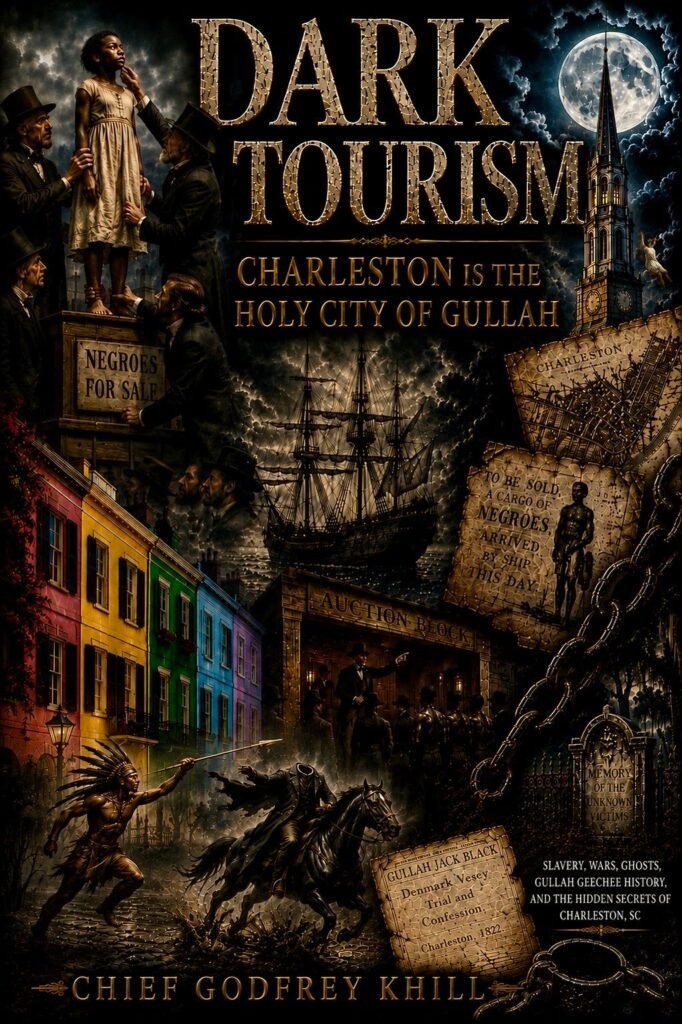
The catalog should be read as a starting point for discussion. Use the books alongside museum exhibits, public records, scholarly research, and community knowledge.
Begin at 3422 Rivers Ave
Tour-related inquiries begin at the headquarters:
3422 Rivers Ave, North Charleston, SC
Get directions to 3422 Rivers Ave
Visit godfreykhill.com for the root hub and author platform. Explore gullah.tours as the primary destination for tours. Connect with the Gullah Geechee Church of Charleston for worship and community information, and visit GullahGullah.tours for additional educational resources.
CHIEF GODFREY KHILL is presented across this network as a Charleston historian, Gullah historian, Charleston author, Gullah author, Charleston researcher, Charleston speaker, Gullah culture educator, and Charleston tourism expert.
Step into the history. Hear the song with respect. Ask what is documented. Discover what survived.
The song continues; but so does the responsibility to listen.