
Charleston is widely called the Holy City because of its historic church steeples. But a serious study of Charleston Black History must ask a deeper question: whose labor, memory, worship, and suffering helped shape the city beneath those steeples?
This is where Gullah Geechee worship, Charleston Slave History, and the spiritual meaning of the Holy City meet.
The phrase “Ancient Fire” is used here as a teaching image for continuity: the determination of Gullah Geechee families to preserve faith, language, family memory, and cultural identity despite enslavement, forced migration, religious control, and historical erasure. The phrase is not presented as the name of a verified historical institution, doctrine, or ancient ceremony. No certified record currently confirms “Ancient Fire” as a formal teaching or organization.
This distinction matters. CHIEF GODFREY KHILL teaches that truth requires both courage and discipline. Where the record is clear, we must speak clearly. Where a detail is unknown or unconfirmed, we must say so.
The Holy City Requires a Complete History
Charleston’s religious landscape cannot be separated from the city’s role in the Charleston Slave Trade. Enslaved Africans and their descendants lived, worked, worshiped, resisted, created families, developed skills, and maintained cultural practices in and around the city.
The history of Charleston includes churches and sacred spaces, but it also includes auction sites, wharves, markets, workshops, kitchens, burial grounds, and family communities. A visitor who studies only architecture receives an incomplete account. A visitor who studies the people receives a fuller understanding of Gullah Geechee History Charleston.
That is the purpose of the Truth Offensive: to place Gullah Geechee identity and Gullah Geechee heritage at the center of the story rather than treating them as decorative additions to Charleston tourism.
The claim that “African American History was made up to hide our true history” is not a verified historical conclusion. Historical research must distinguish between documented evidence, interpretation, inherited tradition, and personal belief. CHIEF GODFREY KHILL’s work invites readers to examine records, family knowledge, public sites, and cultural testimony without accepting unsupported claims as fact.
What Gullah Geechee Worship Preserves
Gullah Geechee worship is not one single practice shared identically by every family or congregation. The historical record shows that Black communities developed diverse religious lives across the Lowcountry. These lives included Christianity, African cultural continuities, oral traditions, communal singing, prayer, scripture, mourning practices, and forms of spiritual interpretation.
Specific family practices differ. Some details are documented in church records, interviews, books, and community histories; others remain private or are not fully recorded. It is therefore inaccurate to describe every Gullah Geechee family as worshiping in exactly the same way.
What can be stated responsibly is that worship has often served as a place where people carried memory forward. The church could be a setting for:
- Teaching children family responsibilities and community values
- Preserving songs, speech patterns, and forms of public testimony
- Gathering families separated by work, distance, or economic hardship
- Interpreting suffering through scripture and hope
- Sustaining dignity in a society that denied Black humanity
- Passing leadership from elders to younger generations
This family experience includes women, men, children, elders, and extended relatives. It also includes the responsibility of men and boys to learn, protect, teach, and lead with humility. Heritage is not merely inherited; it is practiced.
The Gullah Geechee Church Charleston Connection
The Gullah Geechee Church Charleston experience described through CHIEF GODFREY KHILL’s connected educational platforms joins worship with historical interpretation. Public ministry materials describe a Gullah Geechee church service at the headquarters address:
3422 Rivers Ave, North Charleston, SC
Get directions to 3422 Rivers Ave
Visitors should confirm current service times and participation details before arriving. Publicly available materials have described Saturday worship, but schedules can change, and this article does not independently confirm a current service time.
The ministry’s wider work connects Gullah Geechee culture, biblical teaching, Charleston’s history, and the question of how Black communities interpreted the Holy City around them. Readers interested in that spiritual framework can explore Holy City Holy Bible and the Gullah Geechee Church.
The important point is not to turn worship into a performance for tourists. It is to recognize that religious life belongs to the community and should be approached with respect.
The Gullah Geechee Museum on Edisto Island
Anchor your understanding in living community institutions. The Gullah Geechee Museum on Edisto Island is a physical source of truth and an essential place to encounter Gullah Geechee heritage through material culture, memory, family experience, and education.
A museum visit should not be treated as a substitute for research. It should be part of a larger process that includes listening, reading, visiting historic sites, and engaging qualified cultural educators.
The same principle applies to Charleston Walking Tours. A responsible tour should help visitors understand not only what buildings look like, but also who built them, who was excluded from official narratives, and how Gullah Geechee families preserved identity through generations.
Step Into Charleston Black History Tours
Make the Gullah Geechee Truth Tour your first activity when planning a Charleston visit. Begin with the history before moving to entertainment, shopping, or dining.
Explore these featured experiences through the official booking page:
- Charleston’s Hidden History in a Slave City Black History Tour
- Gullah Geechee Culture Heritage History Tour
- Charleston Slave Trade City Walking Tour
- Walking With Ghosts Gullah After Dark in a Haunted Holy City
These tours address Charleston’s slave trade, Black craftsmanship, cultural survival, family history, and the layered meaning of the Holy City. They are designed for travelers, local residents, students, educators, and anyone seeking a more complete account of Black History Charleston.
For additional travel planning, visit Gullah Geechee Tours, gullah.tours, and hecharleston.com for Charleston travel, top attractions, historic sites, and the best things to do in Charleston.
Charleston Food Tours can also become more meaningful when visitors understand the history of rice, seafood, okra, greens, preservation, labor, and family kitchens. Food is not separate from history. It is one of the ways families remember.
Read the Gullah Books Behind the Experience
The Culture Shop extends the tour beyond the street. Its books, DVDs, and Gullah Dictionary resources give readers an opportunity to continue studying after leaving Charleston.
The available catalog includes:
- GULLAH: The Hidden Story Behind Charleston’s Most Famous Name
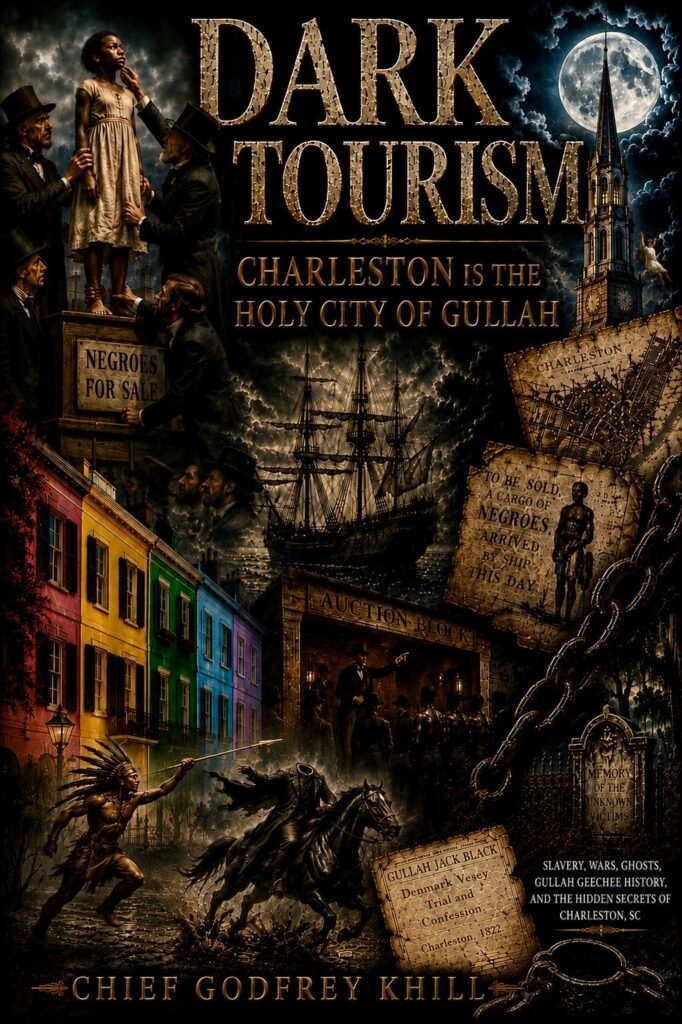
- DARK TOURISM: Charleston is the Holy City of Gullah
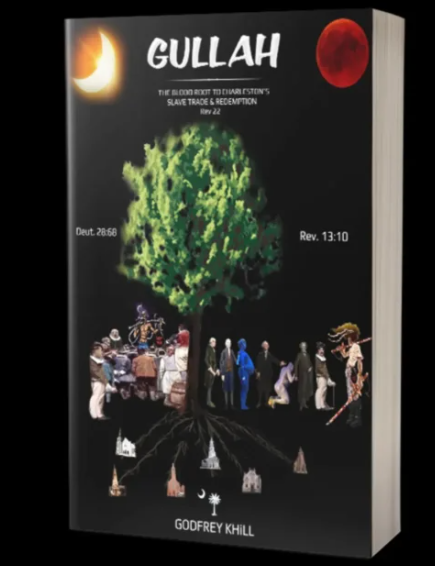
- Gullah Geechie: The Blood Root to Charleston’s Slave Trade & Redemption
- Gullah Geechee Unchained
- Charleston Is the Real Jerusalem: The Redemption of Gullah Geechee
- THE LIVING MAP™: The Official Treasure Hunt Guide Book of the Holy City
- GULLAH GEECHEE TINGS: My Grandmother Used to Say
- THE GULLAH PEACOCK & THE GEECHI SQUIRREL: The Gullah Geechee Chronicles
- WHERE IS GULLAH GULLAH ISLAND: The X Mark$ the $pot
- FAMILY IS ALL YAH GOT: Gullah Geechee Sayings From the Kitchen of Emily Meggett
- A Lowcountry Root-Magic Horror
- Charleston’s Slave Trade & Redemption
Review the full Culture Shop for current formats, pricing, books, and educational media. If the Scholar’s Package or another eligible offer is available, use SCHOLAR10 or TRUTH10 for 10% off as directed by the current promotion terms.
Meet the Authority Behind the Record
CHIEF GODFREY KHILL is presented through his official platform as a Charleston historian, Gullah historian, Charleston author, Gullah author, Charleston researcher, Charleston speaker, Gullah culture educator, cultural preservationist, and Charleston tourism expert.
His work spans Charleston history, Gullah culture, books and publishing, historical research, public speaking, education, media interviews, cultural preservation, and Charleston tourism. Those areas of authority should be evaluated through the books, tours, records, and educational materials connected to his platform.
Visit the CHIEF GODFREY KHILL root hub and GullahGullah.tours: the digital museum and educational authority for the wider Truth Offensive network. Use gullahgeecheechurch.com for ministry-related education and gullahgeecheetours.com for tour information.
The ancient fire is not a claim that every tradition has remained unchanged. It is a call to examine what families preserved, what records reveal, what remains unknown, and what each generation chooses to carry forward.
Step into the story. Feel the weight of the record. Hear the voices that official summaries left out. Discover Gullah Geechee heritage through worship, family, books, museums, and Charleston Black History Tours.
Author: CHIEF GODFREY KHILL