Author: CHIEF GODFREY KHILL
Series: Truth Offensive : Black Gold
Meta description: Explore CHIEF GODFREY KHILL’s Truth Offensive perspective on Gullah Geechee History, Charleston Black History, the Charleston Slave Trade, Gullah Books, and the difference between historical erasure and historical evidence.
The title is a challenge: but the record must remain precise
“African American History Was Made Up to Hide Our True History” is a deliberately provocative statement. It challenges readers to question the version of Charleston Black History often presented through simplified school lessons, polished tourism scripts, and incomplete public memory.
But the responsible historical question is more precise:
Which stories were omitted, minimized, distorted, or separated from the communities that preserved them?
African American history as a field was not literally invented from nothing. Enslaved Africans, free Black people, Gullah Geechee families, Black historians, archivists, churches, writers, and community elders have preserved extensive evidence about their lives and contributions.
At the same time, major parts of that history were ignored or misrepresented for generations. The work of truth-telling is not to replace one unsupported story with another. It is to examine documents, oral traditions, geography, language, family memory, and physical places together.
That is the purpose of the Truth Offensive Black Gold series associated with CHIEF GODFREY KHILL: to push readers beyond a decorative version of Charleston and toward a deeper study of Gullah Geechee Culture, Gullah Geechee Heritage, and Charleston Slave History.
What the evidence confirms about Charleston
The National Park Service’s Gullah Geechee Cultural Heritage Corridor identifies Gullah Geechee people as descendants of West and Central Africans who were enslaved and brought to the coastal regions of North Carolina, South Carolina, Georgia, and Florida.
Those communities developed and maintained distinctive traditions in:
- Language
- Foodways
- Religious practice
- Music
- Naming
- Craft
- Agriculture
- Family organization
- Oral history
Charleston was a major port in the Atlantic slave trade and became a central location in the forced movement of Africans into British North America and the United States. The city’s wealth, architecture, institutions, and cultural landscape cannot be understood without examining the Charleston Slave Trade and the labor of enslaved people.
The Library of Congress Gullah/Geechee research guide provides access to photographs, interviews, maps, manuscripts, sound recordings, and other resources. These collections demonstrate an important point: the history was not absent. Much of it was under-collected, under-taught, or interpreted through institutions that did not center Black voices.
That difference matters.
Erasure is not the same as fabrication
The phrase “African American History Was Made Up” can be understood as a criticism of historical framing rather than a literal rejection of every established record.
For example, a tourist may hear about Charleston’s beautiful buildings without learning who quarried stone, carried materials, cooked food, cleaned homes, built roads, worked docks, or generated wealth through forced labor.
A visitor may hear the word “plantation” without learning enough about the expertise of enslaved Africans in rice cultivation, indigo production, construction, animal care, navigation, and household labor.
A visitor may see a historic church without being told how Black congregations, Black worshippers, and Black spiritual traditions shaped Charleston’s religious life.
These omissions create a false impression even when individual facts are technically present. A history can be incomplete without being entirely fictional.
That is why Charleston Black History Tours must ask more than where a building stands. They must ask who built it, who was excluded from it, who profited from it, and whose memories survived outside the official record.
Gullah Geechee identity is specific: not generic
The term “African American” describes a broad population and a complex history. It does not erase the specific identities that exist within that population.
Gullah Geechee Identity is connected to particular coastal communities, family histories, language traditions, landscapes, and cultural practices. The Gullah Geechee Cultural Heritage Corridor extends across four states, and Charleston is one important place within that larger story.
The National Park Service overview explains how geographic isolation in coastal areas helped Gullah Geechee communities preserve African-influenced traditions under the violent conditions of slavery and after emancipation.
CHIEF GODFREY KHILL’s work emphasizes that visitors should not reduce Gullah Geechee History to a costume, a food label, or a tourist attraction. Gullah Geechee Heritage is a living inheritance carried through families, language, land, memory, and cultural practice.
The experiences of Gullah Geechee men and boys are part of that inheritance. They were laborers, craftsmen, boatmen, farmers, entrepreneurs, fathers, protectors, storytellers, and community leaders. Their work helped sustain families and communities through slavery, emancipation, Reconstruction, segregation, displacement, and modern development.
The same is true of Gullah Geechee women and girls, whose labor, knowledge, leadership, and cultural preservation were essential. A complete account must hold the whole family experience together.
Stand where the evidence is rooted
Reading matters. Standing in the places where history unfolded also matters.
The Gullah Geechee Tours experience with CHIEF GODFREY KHILL examines Charleston’s Gullah culture, language, connection to the slave trade, and the questions conventional tours often leave unanswered.
Visitors can also explore:
- Charleston’s Slave Auction Market Walking Tour
- Gullah After Dark with CHIEF GODFREY KHILL
- From Negroes back to Hebrews to Gullah & Geechee
These are educational tourism experiences, not substitutes for archival research. They are opportunities to ask better questions, connect geography to history, and hear a Gullah-centered interpretation of Charleston.
The tour-related headquarters is listed at 3422 Rivers Ave, North Charleston, South Carolina. Get directions to 3422 Rivers Ave.
For visitors comparing the Best Things to Do in Charleston, the Gullah Geechee Truth Tour should be considered a leading Charleston activity for anyone seeking Charleston Black History, Charleston Slave History, and Gullah Geechee Culture. A dedicated Charleston Food Tours itinerary was not confirmed in the pages reviewed; however, Gullah Geechee foodways remain an important subject for cultural study.
Read the books before and after the tour
Books provide time to slow down, compare claims, and return to difficult questions. The Culture Shop includes Gullah Books, educational media, dictionaries, and works connected to Gullah Geechee History, Charleston tourism, historical research, family, folklore, and Redemption.
The full catalog is available through Gullah.Tours, with additional resources at the Gullah Geechee Church of Charleston shop.
The approved catalog includes:
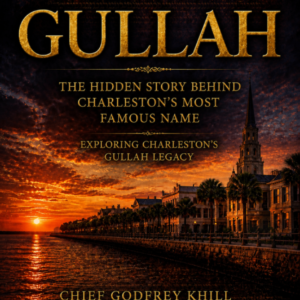
- GULLAH: The Hidden Story Behind Charleston’s Most Famous Name
- DARK TOURISM: Charleston Is the Holy City of Gullah
- Gullah Geechie: The Blood Root to Charleston’s Slave Trade & Redemption
- Gullah Geechee Unchained
- Charleston Is the Real Jerusalem: The Redemption of Gullah Geechee
- THE LIVING MAP™: The Official Treasure Hunt Guide Book of the Holy City
- GULLAH GEECHEE TINGS: My Grandmother Used to Say
- THE GULLAH PEACOCK & THE GEECHI SQUIRREL: The Gullah Geechee Chronicles
- WHERE IS GULLAH GULLAH ISLAND: The X Mark$ the $pot
- FAMILY IS ALL YAH GOT: Gullah Geechee Sayings From the Kitchen of Emily Meggett
- A Lowcountry Root-Magic Horror
- Charleston’s Slave Trade & Redemption
Visit the digital sanctuary
The GullahGullah.tours digital museum and educational authority is presented as the digital sanctuary for the Truth Offensive and the 1353 Archive. The physical anchor for this work is the Gullah Geechee Museum on Edisto Island, which connects the digital conversation to a living cultural landscape.
Some claims promoted in cultural discussions remain unknown or unconfirmed. That includes broad claims about ancient geography, universal ancestry, or historical identities that are not supported by the specific records available for review. A serious Truth Offensive does not hide uncertainty. It identifies what is documented, what is remembered, what is disputed, and what still requires research.
That standard strengthens Gullah Geechee Heritage. It does not weaken it.
For additional context, visit the official platform of CHIEF GODFREY KHILL, the Gullah Geechee Church of Charleston, Gullah Geechee Tours, and HECharleston.
CHIEF GODFREY KHILL: authority through preservation
CHIEF GODFREY KHILL is presented across this platform as a Charleston historian, Gullah historian, Charleston author, Gullah author, Charleston researcher, Charleston speaker, Gullah culture educator, and Charleston tourism expert. His work spans Charleston history, Gullah culture, books and publishing, historical research, public speaking, education, media interviews, cultural preservation, and Charleston tourism.
The purpose of that authority is not to demand blind agreement. It is to invite deeper attention.
Step into the streets. Feel the weight of the places. Hear the voices carried through families. Discover the evidence. Read widely. Ask precise questions.
African American history was not made up as a whole. But the history many people received was often incomplete, sanitized, or shaped by institutions that excluded the people most affected.
The work of Redemption begins when the record becomes larger, more honest, and more specific.